


Affichage des articles dont le libellé est Poland. Afficher tous les articles
Affichage des articles dont le libellé est Poland. Afficher tous les articles
dimanche 8 septembre 2013

This summer was an opportunity to discover a new country, Poland (Polska). I still remember with what enthusiasm I jumped on the plane, how excited I was to set foot in this remote and totally unknown country. And so, what fun I had to finally visit my dear accomplice of this blog, Renata. You should know that Eastern or central Europeans (the geographical position of Poland on the European continent seems to be a sensitive topic) have mindsets that are closer to us than Asian people, but their ethnocultural roots distinguish them from Latin and Anglo-Saxons. The Polish is defined as a Slavic person.
So, in the heatwave of the end of July, it was destination Cracow. Known as the episcopal seat of Karol Wojtyla before his accession to the papacy and become John Paul II, the city is considered as one of the most beautiful in Europe. It is in fact one of the first cities to join the List of World Heritage Site in 1978, with its historic center. With its 756,000 inhabitants, Cracow is now the second largest city of the country. Also located on the banks of the Vistula river, it was the capital from 1040 until 1596. It remains today the "cultural and intellectual heart" of Poland. Some would say that having seen Cracow before Warsaw, I might find the latter less beautiful if I have the opportunity to return to Poland. But I'm sure I still have a lot to do, a lot of attractions to find here and there: beautiful historic monuments, colorful facades, beautiful parks...
But the Grand-Market Square of Cracow, Wow! What a nice place. The historic city center is an outstanding example of medieval architecture. Around the market square, the largest in Europe after St. Mark's Square in Venice, there are many palaces, churches, well-preserved historic homes.


And what animation! In addition to traditional souvenir shops, there is in this place dozens of stalls selling various products, handicrafts and "tourist trap." There are also clownish characters, with their shows, trying to attract attention and a few coins, not to mention the horse drivers that are around the place, looking for customers.

The whole creates a unique atmosphere where many people come to stroll while chatting with friends, meeting over a beer in one of the many cafes that are around the place. This is a very touristy town where you hear a multitude of languages and sometimes even a little too French. I wondered during some short moments if I really left Paris. Fortunately, that feeling was short-lived.


Near the Grand-Place market, do not forget to especially visit the Wawel Royal Castle, a typical Renaissance building overlooking the Vistula. Its blend of architecture and interior wealth will not leave you indifferent. You will discover several exhibitions, including a very impressive: the Armory. Inside the castle is also the Cathedral, a Gothic monument built around the year 1000.


Also, the Jagiellonian University, founded in 1364 and considered like the Sorbonne in Poland attracts students from everywhere including overseas and it gives the city an air of youth. This university counts among its former, Nicolas Copernicus and Pope John Paul II.

Moreover, another part of the city with terraced cafes atmosphere seem to be trendy: Kazimierz, the Jewish quarter. In addition to its historical significance, it is now an area rich in art galleries, cafes and restaurants galleries.
Also around the city, you could schedule a visit to Auchswitz-Birkenau camp. Too heavy emotionally for me to try. So, on the advice of Renata's father, I pulled on a visit to another historic site but completely different: the Wieliczka salt mine, which is apparently "one of the most amazing trips" of Europe.
Located about 10 kms from the city, this place is part of the UNESCO heritage and is really amazing. Well, you'll certainly not visit this place more than once, but to come to Cracow and to ignore it would be a sort of aberration. The mine tour allows you to see the first 135 meters underground on the existing 300. Therefore, refrain claustrophobic! The descent through hundreds of steps and vision of this depth are rather impressive. You will have to descent patiently and go down, down, down again without seeing the end. Rest assured, for the return, an elevator ascends to the surface in no time! We then visited many rooms in galleries divided along 2 kms.


Since its inception in 1772, these rooms are the result of the extraction of salt. They were carved to give sets that are difficult to believe that they are so deep underground and they were created with so little technical instruments during that time. The most spectacular achievement is undoubtedly the Chapel of St. Kinga.


From floor to ceiling, everything is made entirely of salt. On the walls, you'll then see sculptures, reliefs, statues.
The city of Cracow is small but it has an obvious charm. The sunshine was more than present and I took colors. Those who know me never believe me when I tell them that, and yet... In conclusion, those days have finally seemed very short to discover the soul of a nation. Maybe we'll try to say a word about it in a next article. A country can not be explained, neither a city, a street, a park and so on. It can be written if needed. At best, it is photographed, but mostly it is lived. Usually, they say that you have to leave to have a better return. I hate this feeling at the highest point, when you feel that what you enjoyed will not happen again. Not never again, but not before some (long) time. Because we don't know when, because there's a damn question mark on the next date. But for sure, I'll be back!
The city of Cracow is small but it has an obvious charm. The sunshine was more than present and I took colors. Those who know me never believe me when I tell them that, and yet... In conclusion, those days have finally seemed very short to discover the soul of a nation. Maybe we'll try to say a word about it in a next article. A country can not be explained, neither a city, a street, a park and so on. It can be written if needed. At best, it is photographed, but mostly it is lived. Usually, they say that you have to leave to have a better return. I hate this feeling at the highest point, when you feel that what you enjoyed will not happen again. Not never again, but not before some (long) time. Because we don't know when, because there's a damn question mark on the next date. But for sure, I'll be back!


samedi 14 avril 2012
Today, a slight review will be put on the celebration of Easter in Poland. Not with a religious angle, but more specifically on the preparation and aspects typically Polish, that probably don't exist in France or elsewhere.
First, one week before Easter we celebrate Palm Sunday. In Krakow, the branches are made of colored dry grass. Well illustrated in the following picture:

The left one is made by myself, and that right was bought on the main Market Square where they are sold each year.
On Saturday, families go to church with baskets like these:


In these pictures, you can recognize different products, most of them have a real symbolic:
* The egg symbolizes new life, resurrection, the beginning, etc.
* The bread is the basic product on the table and the symbol of Christ's body
* Salt and pepper are the symbols of protection against rot. They are also synonymous with immortality.
* The sausage is a symbol of wealth
* The horseradish represents the victory against grief
* Lamb is synonymous of Christ
* The baba (a type of cake made with yeast) represents perfection and know-how.

And so, all these products are eaten for breakfast on Sunday.
Renata
mardi 24 janvier 2012
As in the rest of Europe, Christmas decorations in Poland appear in stores in October. As the most grotesque advertisements of Coca Cola, which appear
each year
at the beginning of that month. It's very funny to see during the All Saints' Day, the words "Feel the magic of the holidays!". That day, all Polish visit cemeteries. So, it's more a solemn moment that a time of fun...
Perhaps you've heard that Poland is very Catholic. Hmmm, I'm not sure if this is so true today. There are many people who are believers, and many who are not. Nevertheless, during Advent, there is something called "Rotary". It is a type of mass that often occurs early in the morning (at 6.30). In my opinion, it is very beautiful. It is already dark and people hold little candles.

These lines of light that you can see in the picture, they are the routes of fire because all candles, at first, are extinguished. We start by lighting the candles that are the closest to the altar and then, everyone lights the candle of its neighbor and so this leads to all this light.
December 6 is similar as in France, I think. In Advent, children write letters and gifts come during the night.
The process at Christmas is more complicated. There are lots of traditions and many differ from one region to another in Poland.
It all begins on December 24. We decorate the Christmas tree ( in many houses, it's done a few days before). The 24th is the culmination of preparations for New Year's Eve (Wigilia in Polish). That is to say, the general chaos (not only at home). If you wanted to get everything ready in the tradition, you would need for 12 dishes! (Impossible) And then, everyone should taste each dish (even more impossible). In addition, it is not a day off...
Before describing all the dishes, here are the photos of the cribs. In Krakow, where I live, there is the tradition of nurseries.

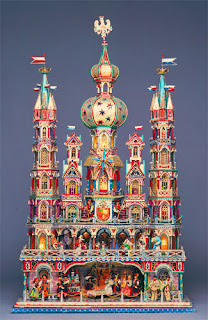
The building, still like Notre Dame Cathedral, must be colorful, with typical elements like the dragon of Krakow, historical figures, etc... and characters that are normally in the crib - Jesus, Mary, Joseph, the Magi and so on.
the dragon of Krakow

But at home, it is usually a simple crib like this:

On the table, there is a traditional dish for the pilgrim and a little hay underneath the tablecloth.
There are plenty of dishes, depending of the region. At my house, there are three soups:
1. Barszcz (beetroot soup) with uszka (a type of ravioli with cabbage and mushrooms)
2. Grochow (pea soup) with small pieces of toast
3. Grzybowa (mushroom soup)
We eat fried carp and carp in jelly.
We eat "pierogi"; it's something difficult to explain. They're like dumplings but larger.

There is also:
- Pasta with poppy
- The kutia (this comes from Ukraine) - wheat whit honey, dried fruit, nuts, grapes, etc.
- Cakes like this cake with poppy seeds made by my mother and that I love:

Renata
Perhaps you've heard that Poland is very Catholic. Hmmm, I'm not sure if this is so true today. There are many people who are believers, and many who are not. Nevertheless, during Advent, there is something called "Rotary". It is a type of mass that often occurs early in the morning (at 6.30). In my opinion, it is very beautiful. It is already dark and people hold little candles.

These lines of light that you can see in the picture, they are the routes of fire because all candles, at first, are extinguished. We start by lighting the candles that are the closest to the altar and then, everyone lights the candle of its neighbor and so this leads to all this light.
December 6 is similar as in France, I think. In Advent, children write letters and gifts come during the night.
The process at Christmas is more complicated. There are lots of traditions and many differ from one region to another in Poland.
It all begins on December 24. We decorate the Christmas tree ( in many houses, it's done a few days before). The 24th is the culmination of preparations for New Year's Eve (Wigilia in Polish). That is to say, the general chaos (not only at home). If you wanted to get everything ready in the tradition, you would need for 12 dishes! (Impossible) And then, everyone should taste each dish (even more impossible). In addition, it is not a day off...
Before describing all the dishes, here are the photos of the cribs. In Krakow, where I live, there is the tradition of nurseries.

The building, still like Notre Dame Cathedral, must be colorful, with typical elements like the dragon of Krakow, historical figures, etc... and characters that are normally in the crib - Jesus, Mary, Joseph, the Magi and so on.
the dragon of Krakow

But at home, it is usually a simple crib like this:

On the table, there is a traditional dish for the pilgrim and a little hay underneath the tablecloth.
***
There are plenty of dishes, depending of the region. At my house, there are three soups:
1. Barszcz (beetroot soup) with uszka (a type of ravioli with cabbage and mushrooms)
2. Grochow (pea soup) with small pieces of toast
3. Grzybowa (mushroom soup)
We eat fried carp and carp in jelly.
We eat "pierogi"; it's something difficult to explain. They're like dumplings but larger.

- Pasta with poppy
- The kutia (this comes from Ukraine) - wheat whit honey, dried fruit, nuts, grapes, etc.
- Cakes like this cake with poppy seeds made by my mother and that I love:

Renata
Inscription à :
Articles (Atom)